When asked on July 15 about the ongoing Jeffrey Epstein controversy, President Trump said “It’s pretty boring stuff. It’s sordid, but it’s boring and I don’t understand why it keeps going.”
The frustration is of his own doing, and it was this statement that swelled my curiosity. So down the rabbit hole I went.
The issue is this: the Epstein files debacle, centering upon the elusive “client list,” illustrates how scandals can erode public faith in institutions while highlighting systemic (if not deliberate) failures in accountability.
Jeffrey Epstein, the convicted sex offender who died in 2019, allegedly ran a trafficking network exploiting minors, drawing in powerful figures from politics, finance, and entertainment.
Court documents unsealed last year from Virginia Giuffre’s lawsuit against Ghislaine Maxwell named over 150 associates, including the likes of Bill Clinton and Prince Andrew, among others – though mere mention doesn’t necessarily imply guilt. Yet the full scope remains obscured, fueling speculation via partial disclosures and reversals.
Naturally this matters because of reported contradictions and political red tape. Last February, Attorney General Pam Bondi released a “first phase” of declassified files – flight logs and contacts – but they were heavily redacted and largely recycled from prior leaks, offering no major revelations.
Trump promised transparency, yet five months later the DOJ and FBI concluded that no “client list” exists, reaffirming Epstein’s suicide and halting further releases. This U-turn sparked backlash, with Trump labeling the furor a “Democrat hoax” and dismissing calls for more documents, alienating even his staunchest supporters.
Bureaucratic hurdles, like victim protections and internal reviews, justify delays. But critics see a cover-up shielding bipartisan elites, made seemingly evident in blocked Democratic efforts and Republican resistance.
The implications are far-reaching for Washington DC power players and international elites. Names like Clinton (mentioned in depositions without accusations) and Trump himself (who banned Epstein from Mar-a-Lago but faced scrutiny over ties) underscore how such networks transcend parties, potentially involving blackmail or influence peddling.
Globally, figures such as Prince Andrew settled lawsuits amid abuse claims, while others like Alan Dershowitz fought allegations. Unresolved, it risks a scandal that can topple a career, as seen with the resignation of Barclays CEO Jes Staley.
For the average person, this matters for different reasons because it reveals two-tiered justice in which elites evade scrutiny, whereas ordinary citizens would likely face irrecoverable consequences if faced with similar indictments.
Obviously the horrors of child trafficking demand accountability to protect the vulnerable, and the saga erodes trust in government, media, and law enforcement amid conspiracy theories. In a polarized era, nonpartisan transparency could rebuild faith, but the shroud persists, reminding us that power often protects itself.
Questions about the video footage from Jeffrey Epstein’s time at the Metropolitan Correctional Center in New York City has deepened suspicions of foul play and institutional cover-ups, amplifying the Epstein saga’s erosion of public trust.
Epstein was found dead on August 10, 2019. (Damn has it been almost six years already?) His death was ruled a suicide by hanging, but initial reports revealed systemic failures: approximately half of the MCC’s 150 analog cameras, including most in the Special Housing Unit where he was held, malfunctioned starting July 29 due to “technical errors,” which prevented recordings.
Repairs were scheduled for August 9 but delayed, leaving only two operational cameras – one overlooking the SHU common area and another on elevators – and neither captured his cell door directly.
Early accounts noted unusable footage from at least one hallway camera, sent to FBI labs, while prosecutors admitted “technical errors” erased video from Epstein’s suicide attempt on July 23 by saving the wrong cell’s feed.
This month, Attorney General Pam Bondi released what the DOJ called “full raw” footage from the SHU camera to affirm the suicide ruling and quash theories. However, metadata analysis by WIRED and forensics experts revealed it was far from raw – in fact the footage was modified using Adobe Premiere Pro, stitched from at least two clips, saved multiple times on May 23, 2025, and exported with internal markers.
Nearly three minutes were cut, starting at a one-minute gap (11:58:58 p.m. to 12:00:00 a.m.), which Bondi attributed to a daily system reset. But experts called this implausible, noting unnatural jumps, aspect ratio shifts, visible cursors, and duplicate frames indicating purposeful tampering.
Digital forensics analyst Jake Green described it as “unnerving,” accusing the FBI of altering the video, violating best practices, and making the situation “stink even worse.”
Politically, the entire situation highlights red tape and contradictions. The 2019 probe occurred under Trump’s first term, yet releases under his second have sparked intra-MAGA rifts, with Trump dismissing critics as duped by a “Democrat hoax” while influencers decry a bipartisan shield for elites.
Implications ripple to DC and global power players, implicating figures like Clinton and Trump in associations, potentially involving blackmail networks, and risking scandals that could destabilize institutions if fully exposed. For everyday people, it underscores a recurring theme of unequal justice.
While guards faced charges for falsifying logs, the altered footage suggests evidence manipulation to protect the powerful, perpetuating child exploitation’s horrors without accountability. In an era of deepfakes and distrust, it erodes faith in government transparency, reminding us that obscured truths hinder healing for victims and breed societal division.
True nonpartisan oversight could restore credibility, but the shroud persists.
Trump is wrong. This is anything but boring.
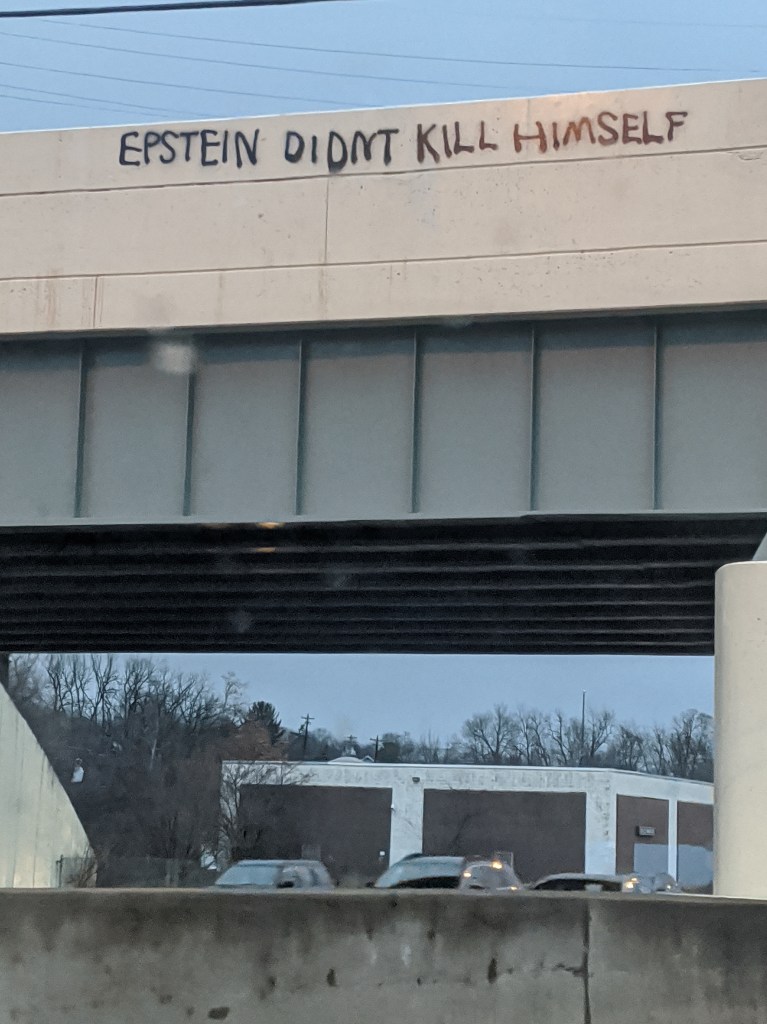
Picture of an overpass on Interstate 71 in Cincinnati taken by an unknown photographer
 New Hickory