Bodhi’s prophecy about a 50-year storm on the other side of the world in which “…the ocean lets us know just how small we really are” had Special Agent Utah spellbound. As a kid who saw Point Break at a theater in the Raleigh neighborhood of Memphis 34 years ago, practically to the day in fact, I was likewise entranced.
In real life, a 50-year storm refers to a tempest that has a 2% chance of occurring in any given year, and usually involves rainfall events that may or may not lead to enormous surfable swells for those free spirit searchers who “live to get radical,” as the Bodhisattva once put it.
Nevertheless it was this beach fire scene that came to mind a couple of nights ago as I watched a documentary on Surfer TV called White Rhino.
Directed by Brent Storm, this hourlong documentary takes viewers into the odyssey of veteran surf photographer Brian Bielmann, a lensman who has spent decades immortalizing the sport’s most courageous moments.
Bielmann, with his unyielding eye, embarked on a quest to snag that elusive, once-in-a-lifetime shot amid the largest swells ever documented, only to uncover deeper truths about human limits and nature’s raw power.
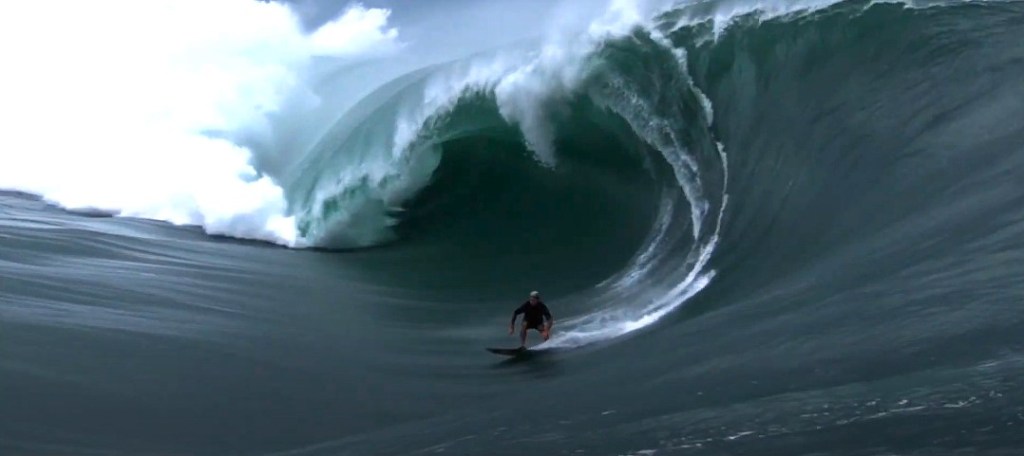
His background as a pioneering shooter infuses the film with authenticity, turning each frame into a testament to the photographer’s own high stakes gamble, jet skiing into the impact zone where one misstep could mean disaster.
At the core are the surfers, a cadre of wave warriors who embody surfing’s glorious peril.
Bruce Irons, the fearless charger (and younger brother of the late three-time world champion Andy Irons), drops into behemoths that could crush dreams in an instant, his rides a poetic fusion of fluidity and defiance.
Nathan Fletcher, innovative and unflinching, endured a cartwheel wipeout that underscored the razor thin line between triumph and tragedy – waves so immense they roar like thunder, their crystalline barrels offering transient beauty before slamming shut with bone-shattering force.
Mark Healey, Kohl Christensen, Dave Wassel, and Kalani Chapman round out the crew, each harnessing the ocean’s fury in sessions that blend exhilaration with existential dread.
These athletes aren’t just riding waves; they’re courting the danger that makes big wave surfing transcendent – hearts pounding as turquoise giants rear up, promising either eternal glory or a watery abyss… or both quite frankly.
Filmed across the South Pacific’s storied breaks during 2011-12, the action unfolds at Teahupo’o in Tahiti and Cloudbreak in Fiji as epic swells fueled by El Niño transformed the seascape into what Brian Bielmann had been hoping for.
Teahupo’o, with its shallow reef and hollow tubes, hosted the infamous Code Red day, where waves exceeded 50 feet, their power a mesmerizing force that could sculpt legends or claim lives.
Cloudbreak, a remote Fijian jewel, delivered flawless, freight-train barrels under stormy skies, amplifying the isolation and intensity.
These locales, drenched with tropical sun yet shadowed by peril, highlight surfing’s allure: the serene glide through a glowing tunnel juxtaposed against the chaotic wipeout, where survival hangs by a thread.
In the heart of the ocean’s untamed symphony, where cobalt walls rise like cathedrals of liquid wrath – that’s a damn good line if I say so myself – White Rhino captures the essence of big wave surfing’s duality: a breathtaking ballet of grace and a perilous dance with oblivion.
White Rhino is more than mere footage; it’s a visceral reminder that in chasing nature’s giants, we discover both the ocean’s poetry and our own impermanence.
Picture captured c/o the Bright Sky Studios YouTube page from a video originally posted on August 13, 2019
 New Hickory